| Year | 1997 | 1998 | 1999 | 2000 | 2001 | 2002 | 2003 | 2004 | 2005 | 2006 | 2007 | 2008 | 2009 | 2010 | 2011 | 2012 | 2013 | 2014 | 2015 | 2016 | 2017 |
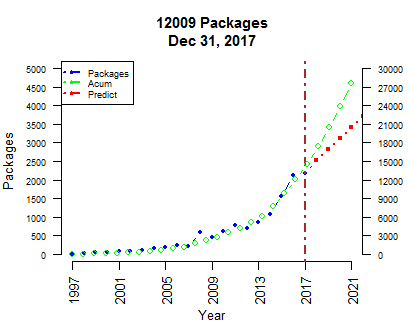
| Packages | 2 | 13 | 57 | 41 | 66 | 66 | 100 | 139 | 187 | 242 | 198 | 572 | 451 | 616 | 777 | 680 | 860 | 1080 | 1562 | 2115 | 2185 |
| AcumPack | 2 | 15 | 72 | 113 | 179 | 245 | 345 | 484 | 671 | 913 | 1111 | 1683 | 2134 | 2750 | 3527 | 4207 | 5067 | 6147 | 7709 | 9824 | 12009 |
Forecasts for 5 years. Is it possible?
| 2018 | 2019 | 2020 | 2021 | 2022 |
| 2526 | 2824 | 3122 | 3419 | 3717 |
| 14535 | 17359 | 20481 | 23900 | 27617 |
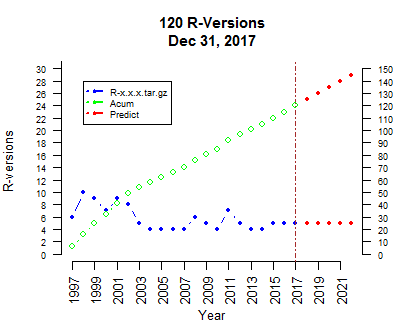
RFreq<-c(6,10,9,7,9,8,5,4,4,4,4,6,5,4,7,5,4,4,5,5,5)
serie <- ts(matrix(RFreq), start=c(1997,1), frequency=1)
fit <- arima( serie, c(0, 1, 1), seasonal = list(order=c(0, 1 ,1),
period=1))
# Forecasts for 5 years
P<-predict(fit,n.ahead =5)
Y<-round(c(serie,P$pred),0)
x<-1997:2022
par(mar=c(4,4,4,3),cex=0.8)
plot(x[1:22],Y[1:22],type="b",axes=F,lwd=1.5,ylab="R-versions",xlab="Year",xlim=c(1997,2022),ylim=c(0,30),pch=20,col="blue")
lines(2018:2022,Y[22:26],col="red",type="b",lty=8,lwd=1.5,pch=20)
axis(1,seq(1997,2022,2),las=2)
axis(2,seq(0,35,2),cex.axis=0.7,las=2)
Z<-rep(0,length(Y))
Z[1]<-Y[1]
for(i in 1:(length(Y)-1))Z[i+1]<-Z[i]+Y[i+1]
abline(h=Z[22],v=2017,lty=4,col="brown",lwd=1.5)
par(new=TRUE)
plot(x[1:21],Z[1:21],type="b",axes=F,lwd=1.5,ylab="",xlab="",xlim=c(1997,2022),ylim=c(0,150),col="green")
lines(x[22:26],Z[22:26],col="red",type="b",lty=8,lwd=1.5,pch=20)
axis(4,seq(0,150,10),cex.axis=0.7,las=2)
title(main="120 R-Versions\nDec 31, 2017")
legend(1998,140,c("R-x.x.x.tar.gz","Acum","Predict"),lty=4,col=c("blue","green","red"),cex=0.7,lwd=2,pch=20)
#######
PackFreq<-c(2, 13, 57, 41, 66, 66, 100, 139, 187, 242, 198, 572,
451, 616,777,680,860,1080,1562,2115,2185)
serie <- ts(matrix(PackFreq), start=c(1997,1), frequency=1)
fit <- arima( serie, c(0, 1, 1), seasonal = list(order=c(0, 1 ,1),
period=1))
# Forecasts for 5 years
P<-predict(fit,n.ahead =5)
Y<-c(serie,P$pred)
x<-1997:2022
par(mar=c(4,4,4,3),cex=0.8)
plot(x[1:22],Y[1:22],type="b",axes=F,lwd=1.5,ylab="Packages",xlab="Year",xlim=c(1997,2021),ylim=c(0,5000),pch=20,col="blue")
lines(x[22:26],Y[22:26],col="red",type="b",lty=8,lwd=2,pch=20)
axis(1,seq(1997,2022,4),las=2)
axis(2,seq(0,5000,500),cex.axis=0.7,las=2)
Z<-rep(0,length(Y))
Z[1]<-Y[1]
for(i in 1:(length(Y)-1))Z[i+1]<-Z[i]+Y[i+1]
abline(v=2017,lty=4,col="brown",lwd=2)
par(new=TRUE)
plot(x,Z,type="b",axes=F,lwd=1.5,ylab="",xlab="",xlim=c(1997,2022),ylim=c(0,30000),col="green")
axis(4,seq(0,30000,3000),cex.axis=0.7,las=2)
title(main="12009 Packages\nDec 31, 2017")
legend("topleft",c("Packages","Acum","Predict"),lty=4,col=c("blue","green","red"),cex=0.7,lwd=2,pch=20)